

Summary: To strengthen tendons and ligaments, load them progressively, stay consistent for months, keep the joint moving, and give your body the building blocks it uses to make collagen. Research on tendons points to how heavy the load is, not the type of exercise, as the main driver. If pain, swelling or instability keeps coming back, an evaluation with the team at Tyrance Orthopedics & Sports Medicine can tell you whether strengthening is enough.
Your muscles feel strong, but do your tendons keep up? Maybe your goal is to get back on the pickleball court, train through a full season or ride again, and the same elbow, knee or ankle keeps flaring up. When the setbacks keep coming, it’s worth looking past the muscle.
Tendons attach muscle to bone, and ligaments hold bones together at the joint. Both respond to how you train them. You bring the goal; our team at Tyrance Orthopedics & Sports Medicine helps you build the plan. Below, you’ll learn how to strengthen tendons and ligaments, from how these tissues adapt to five habits that help, plus what we offer when an injury is already in the way.
How Do Tendons and Ligaments Get Stronger?
Tendons and ligaments adapt to the load you put on them. A 2015 meta-analysis of exercise studies in healthy adults found that tendons are highly responsive to loading, and that how heavy the load is matters more than the type of muscle contraction. In other words, the stimulus counts more than the specific exercise.
| What the research found | What it means for you |
|---|---|
| Loading magnitude plays a key role in tendon adaptation | Use challenging resistance and progress it gradually |
| At high intensity, contraction type (isometric, eccentric or both) made no significant difference | Pick exercises you can do with good form |
| Programs of 12+ weeks tended to show larger effects (not statistically significant) | Plan in months, not weeks |
| Stiffness gains came mainly from the tendon material, not its size | A stronger tendon won’t necessarily look bigger |
A joint also works as a system. Cartilage has no blood supply, so it depends on movement to stay nourished. When pain makes you move less, the joint gets less of that nourishment, and the bone beneath it absorbs much of the force from every step. That’s why we treat bone and joint health together.
5 Ways to Strengthen Tendons and Ligaments
Knowing how to strengthen tendons and ligaments comes down to five consistent habits: progressive load, time, regular movement, nutritional building blocks and smart spacing between hard sessions. None of them replaces an evaluation with our team if something is already injured, but together they give tendons and ligaments what they need to adapt.
- Progress the load. If you’re wondering how to make tendons stronger, load magnitude is what drives tendon adaptation, so use resistance you can control and increase it as the movement gets easier. This matters even more with age, as our guide to staying strong and competitive after 40 explains.
- Stay consistent for months. The tendon review recommends high loading intensity over a longer program, so treat this as an ongoing habit that keeps you moving toward your goal.
- Keep moving between sessions. Regular, comfortable movement keeps the joint nourished. If an injury has already sidelined you, our article on muscle atrophy after injury covers how to protect your strength.
- Give your body the building blocks. In a small study of eight healthy men in The American Journal of Clinical Nutrition, those who took the larger dose of vitamin C-enriched gelatin an hour before short bouts of rope skipping showed double the level of a blood marker of collagen synthesis.
- Space out your hardest sessions. Lab work on engineered ligaments, summarized in a 2017 article in Sports Medicine, suggests tendons and ligaments quickly stop responding to an exercise stimulus, so short bouts of activity (under 10 minutes) separated by long rest periods (about 6 hours) may train these tissues best.
When strengthening isn’t enough: Pain that keeps returning with activity, swelling that doesn’t settle, or a joint that gives way after a twist or fall deserves an evaluation with the team at Tyrance Orthopedics & Sports Medicine before you push harder, especially if ligament healing after a sprain seems stuck.
When a Tendon or Ligament Is Already Injured: How Our Team Can Help
Strengthening is meant for tissue that isn’t hurt yet. If a tendon or ligament is irritated, sprained or torn and you’re looking up how to heal tendons faster, the first step is understanding what’s going on. Our team at Tyrance Orthopedics & Sports Medicine treats these problems with options ranging from in-office regenerative care to arthroscopic repair, depending on the injury.
| If you’re dealing with | Option we offer | What our service page covers |
|---|---|---|
| Tendonitis or a ligament sprain | Platelet-rich plasma (PRP) | Uses your own platelets from a simple blood sample; lists tendonitis and ligament sprains |
| Chronic tendon pain (Achilles, rotator cuff, patellar) | Shockwave therapy | Treats connective tissues such as tendons and ligaments, including chronic tendinopathy |
| A torn ligament, ACL or rotator cuff | Arthroscopic surgery | Repairs rotator cuff tears and torn ligaments and reconstructs the ACL |
| Rebuilding after a sports injury | Sports medicine | Rehab focused on regaining strength, mobility and function |
Regulatory note: PRP is not FDA-approved for any specific orthopedic condition. It is prepared from your own blood, and a review in Current Reviews in Musculoskeletal Medicine explains that it can be legally offered off-label for many musculoskeletal conditions. In Florida, PRP is offered legally with required disclosures. According to the American Academy of Orthopaedic Surgeons, biologics taken from your own body and used the same day have been considered safe enough to use without extensive FDA approvals, but they can still carry risks, which our team reviews with you. Results vary by individual.
Nutrition That Supports Tendon and Ligament Health
What you eat supplies the raw material your connective tissue uses to repair itself. According to the NIH Office of Dietary Supplements, vitamin C is required to make collagen, an essential component of connective tissue. That’s why nutrition works best alongside the loading habits above, not instead of them.
Supplement Support From Avastar Health Systems
As a clinical member of Avastar® Health Systems, our sister brand for supplements, we can point patients who want nutritional support for their tendons and ligaments to JointCare Tendon & Ligament. Avastar describes it as supporting tendon and ligament function and promoting the body’s processes of tendon and ligament self-repair. It complements an evaluation and training plan; it does not replace one.
Before you start a supplement: talk with Tyrance Orthopedics & Sports Medicine first, especially if you are pregnant or nursing, have a medical condition or take medications.
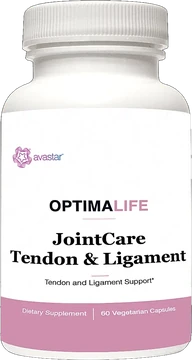
JointCare Tendon & Ligament
An OptimaLife formula that supports tendon and ligament function and promotes the body’s processes of tendon and ligament self-repair. It works best alongside the loading habits above, not instead of them.
Shop JointCareGet Back to What Matters With a Plan
Your goal stays at the center: the training, sport or everyday activity you want back. Learning how to strengthen tendons and ligaments is a long game built on steady, progressive work: load gradually, stay consistent, keep moving and support repair through nutrition.
If pain or instability keeps getting in the way, schedule an evaluation with our team at Tyrance Orthopedics & Sports Medicine, and we’ll help you build a plan around your goal.
Schedule an EvaluationFrequently Asked Questions

Patrick Tyrance, MD
An orthopedic surgeon and former NCAA Academic All-American linebacker and NFL draft pick. Having competed at the highest level, he understands what it takes to get patients back to what they love — with a focus on regenerative, minimally invasive care.
- Practice: Delray Beach, FL
- Profile: About Dr. Tyrance
- LinkedIn: Patrick Tyrance, MD
- [1]Bohm, Mersmann and Arampatzis, human tendon adaptation in response to mechanical loading: a systematic review and meta-analysis, Sports Medicine - Open (2015). pmc.ncbi.nlm.nih.gov/articles/PMC4532714Sports Med Open
- [2]Shaw et al., vitamin C-enriched gelatin supplementation before intermittent activity augments collagen synthesis, Am J Clin Nutr 2017;105:136-143. pmc.ncbi.nlm.nih.gov/articles/PMC5183725AJCN
- [3]Baar K., minimizing injury and maximizing return to play: lessons from engineered ligaments, Sports Medicine 2017;47(Suppl 1):5-11. pmc.ncbi.nlm.nih.gov/articles/PMC5371618Sports Med
- [4]Jones, Togashi and Vangsness, the economics and regulation of PRP, Current Reviews in Musculoskeletal Medicine 2018;11(4):558-565. link.springer.com/article/10.1007/s12178-018-9514-zCurr Rev Musculoskelet Med
- [5]AAOS OrthoInfo, Orthobiologics (Regenerative Medicine) FAQ. orthoinfo.org/treatment/nonsurgical-treatments/orthobiologics-faqAAOS
- [6]NIH Office of Dietary Supplements, Vitamin C: Fact Sheet for Health Professionals. ods.od.nih.gov/factsheets/VitaminC-HealthProfessionalNIH ODS
- [7]Wiesinger, Kösters, Müller and Seynnes, effects of increased loading on in vivo tendon properties, Med Sci Sports Exerc 2015;47(9):1885-1895. journals.lww.com/acsm-msseMSSE