
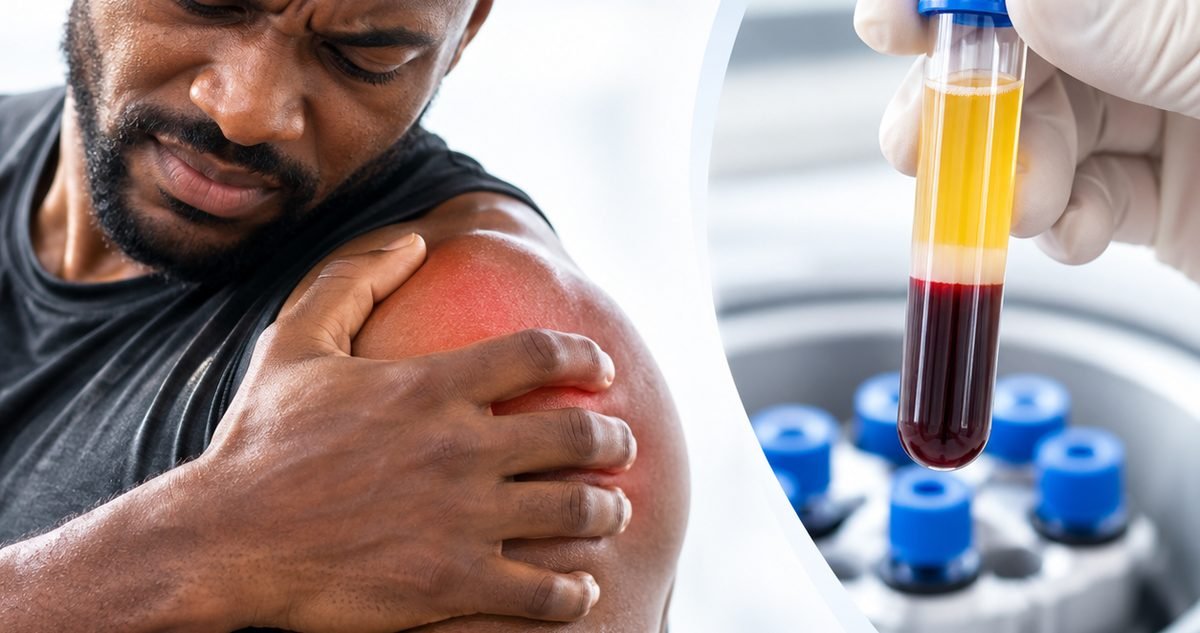
Summary: PRP for the shoulder uses a concentration of your own platelets, drawn from a small blood sample, to support healing in an injured or arthritic shoulder. It is a minimally invasive, in-office injection used for rotator cuff and biceps tendon issues and, in some cases, shoulder osteoarthritis. Unlike cortisone, which gives temporary relief by suppressing inflammation, PRP aims to support long-term healing that builds over weeks.
Shoulder pain has a way of showing up everywhere. Reaching for a seatbelt, washing your hair, sleeping on your side. When a rotator cuff acts up or an aching shoulder joint slows you down, surgery is not always the first or the best step.
PRP for the shoulder offers a different path, one that uses your body's own healing signals to calm pain and support tissue repair, without an operating room. This guide explains what PRP is, which shoulder problems it may help, how it compares to a cortisone shot, and what a treatment actually involves, so you can decide whether it is worth a conversation with the team at Tyrance Orthopedics & Sports Medicine.
What Is PRP for the Shoulder?
PRP, or platelet-rich plasma, concentrates the platelets from a small sample of your own blood and injects them into an injured shoulder. Platelets carry growth factors that help the body repair tissue, so the goal is to support healing at the source rather than only masking the pain. It is one of several regenerative approaches offered through PRP therapy at an orthopedic practice.
Because the sample comes from your own body, PRP is considered a low-risk, minimally invasive option. It is performed in the office rather than a surgical suite, which is part of why it appeals to people who want to explore healing before committing to surgery.
How Does PRP Work?
PRP works by delivering a concentrated dose of platelets and growth factors directly to the damaged area. After a small blood draw, the sample is spun in a centrifuge to separate and concentrate the platelets. That concentrate is then injected into the shoulder, often with image guidance for accuracy.
The idea is to jump-start the body's natural repair process. A growing body of research, including a randomized controlled trial published in the American Journal of Sports Medicine, has examined PRP for tendon and joint conditions, with results that vary by injury type and how the PRP is prepared. As part of a broader regenerative medicine approach, it is often considered when conservative care has stalled but surgery still feels premature.
Shoulder Conditions PRP May Help
PRP is used for a range of shoulder problems tied to tendons, cartilage, and soft tissue. It tends to be considered where healing is slow or incomplete, either on its own or alongside physical therapy. The table below shows where it is most often applied.
| Condition | How PRP is used |
|---|---|
| Rotator cuff tendonitis and certain partial-thickness tears | Injected to support tendon healing in the rotator cuff |
| Biceps tendon issues | Targets the irritated biceps tendon to encourage repair |
| Osteoarthritis (some cases) | Used to calm joint irritation and support the shoulder's cartilage |
One of the most common uses is the rotator cuff, where partial tears and tendon irritation are slow to heal. For a closer look, see our guide to PRP for rotator cuff tears.
PRP vs. Cortisone for Shoulder Pain
The biggest difference is what each injection is trying to do. Cortisone offers temporary relief by suppressing inflammation, so the effect can fade. PRP takes a different aim, supporting long-term healing of the tissue, with results that build over weeks. Neither is right for every case, and the best choice depends on the diagnosis.
| Factor | Cortisone | PRP |
|---|---|---|
| Main goal | Suppress inflammation | Support long-term healing |
| Type of relief | Temporary relief | Healing-based, not just symptom relief |
| Timing | Relief can fade | Builds over weeks |
This is why some people choose PRP after cortisone has stopped helping, or when they want to avoid repeat steroid injections. The two are not interchangeable, and the team at Tyrance Orthopedics & Sports Medicine can explain which fits your situation.
How Tyrance Orthopedics & Sports Medicine Treats Shoulder Pain
At Tyrance Orthopedics & Sports Medicine, PRP is one part of a broader regenerative medicine program built around the causes of shoulder pain. When the problem is tendon irritation, a strained rotator cuff, or early arthritis, PRP is used to support healing in the shoulder rather than only quieting symptoms.
For shoulders that call for more support, the practice also offers BMAC (bone marrow aspirate concentrate), which uses a concentration of cells from your own bone marrow as another regenerative option, along with shockwave therapy, performed alongside regenerative treatments such as PRP and BMAC to support tissue repair. When a corticosteroid alternative fits better, the practice also offers Traumeel, a homeopathic injection with botanicals such as arnica that eases chronic inflammation without the effects a steroid has on normal tissue.
If a targeted injection is the right fit, you can read more about PRP shoulder injections in Delray Beach, or schedule a consultation to find out which regenerative option suits your shoulder.
Is PRP Right for Your Shoulder?
PRP is not the answer for every shoulder. It tends to help most when there is tissue that can still heal, such as tendon irritation, partial tears, or early arthritis. Full-thickness rotator cuff tears with retraction are usually outside what PRP addresses, which is why an exam and imaging at Tyrance Orthopedics & Sports Medicine come first.
Good to know: PRP results vary from person to person, and it is not a guaranteed fix. The type and severity of the injury, your overall health, and how the PRP is prepared all influence the outcome. A consultation with Dr. Tyrance can tell you whether your shoulder is a reasonable candidate.
Because PRP can be combined with other treatments, such as physical therapy or shockwave, it often fits into a larger plan rather than standing alone. That flexibility is part of what makes it worth discussing before deciding on surgery.
Wondering if PRP could help your shoulder? A focused exam is the way to find out.
Schedule an evaluationwith Tyrance Orthopedics & Sports Medicine.
Frequently Asked Questions

Patrick Tyrance, MD
An orthopedic surgeon and former NCAA Academic All-American linebacker and NFL draft pick. Having competed at the highest level, he understands what it takes to get patients back to what they love — with a focus on regenerative, minimally invasive care.
- Practice: Delray Beach, FL
- Profile: About Dr. Tyrance
- LinkedIn: Patrick Tyrance, MD
- [1]a randomized controlled trial published in the American Journal of Sports Medicine. pubmed.ncbi.nlm.nih.gov/23893418PUBMED