

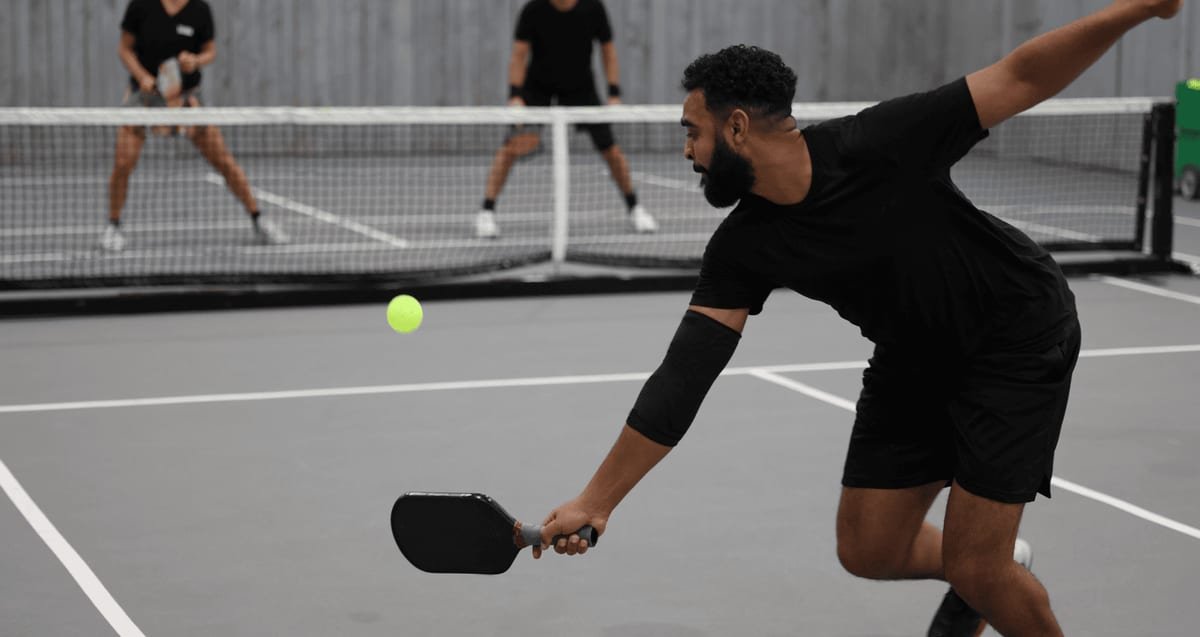
Summary: Pickleball has grown faster than any sport in Palm Beach County, and the injuries follow. Beyond shoulder problems, the knee, ankle, and wrist are common areas where players get hurt. This guide is a Palm Beach orthopedist’s overview of what to watch for, when to be evaluated, and how Tyrance Orthopedics & Sports Medicine approaches treatment.
Pickleball is the fastest-growing sport in much of Palm Beach County, and orthopedic offices have a front-row seat to the consequences. Many players are coming into the sport from a less athletic baseline than their court speed suggests, and the body responds. Shoulder injuries get a lot of attention, but the knee, ankle, and wrist are equally common stops on the orthopedic calendar. This guide is for active players who want to recognize warning signs early, understand what kinds of injuries are typical, and know when an evaluation is worth scheduling.
Why pickleball produces a specific injury pattern
Pickleball involves quick directional changes, lunges, twists, and overhead motions in a compact court area. Add the social aspect (long sessions, multiple matches, often in the heat), and the load on certain joints adds up quickly.
Players who arrived at pickleball without a recent athletic history often discover that their lower extremities were not conditioned for the volume and the change-of-direction demands. The result is an injury pattern that is recognizable to any orthopedic team that sees pickleball players regularly.
Our sports medicine evaluates these injuries as athletic problems with specific patterns, not as generic musculoskeletal complaints.
Knee injuries common in pickleball players
Knee complaints in pickleball players cover a range. We see patellar tendinopathy from repeated lunges, meniscus issues from twisting, mild osteoarthritis flares aggravated by the volume of play, and in some cases ligament injuries from awkward stops or directional changes.
A useful signal is whether the knee complaint resolves between sessions or escalates over weeks. Soreness that fades with a day off is typical of muscle and load adaptation. Pain that returns at the start of every session, swells after play, or limits how you move on the court warrants evaluation.
Some knee injuries respond well to conservative care and activity adjustments. Others may benefit from regenerative options through our regenerative medicine or, in select cases, an arthroscopic procedure.
Ankle injuries common in pickleball players
Ankle sprains are among the most common pickleball injuries we see, particularly when players make quick lateral movements on shoes that were not designed for that load pattern. Repeated minor sprains often add up to chronic ankle instability that needs more than a few days of rest.
Achilles tendinopathy is another frequent complaint, especially in players who increased volume quickly. The pattern of stiffness in the morning, easing with warmup, and returning with prolonged play is classic.
Persistent ankle pain or repeated sprains in the same ankle should not be ignored. The likelihood that something structural is contributing rises with each repeated event.
Wrist and hand injuries we see in players
Wrist injuries in pickleball range from acute strains and sprains from falls or awkward shots to more chronic overuse patterns from gripping the paddle and absorbing repeated impact. Tendinopathy on the thumb side of the wrist (often called de Quervain pattern) is one we see in players who grip heavily.
Hand and finger injuries from falls or paddle contact happen too. Most are minor, but some warrant evaluation, especially if there is persistent swelling, deformity, or loss of motion.
The same evaluation principles apply: pain that improves between sessions is one picture, pain that escalates or limits function is another. The second deserves a closer look.
When to be evaluated and what to expect
Reasonable signals for evaluation include pain that returns at the start of every session, pain that wakes you up at night, swelling that does not resolve with a day or two of rest, mechanical symptoms such as locking or buckling, and any injury that produces immediate inability to play.
The evaluation itself includes a focused exam, a discussion of how you play, and imaging when the exam suggests it would change the plan. We are not chasing scans, and we are not pushing surgery as a default. We are working toward a diagnosis you can act on.
Most pickleball injuries are managed without surgery. The earlier the evaluation, the more conservative options are typically on the table.
Depending on the diagnosis, your plan may combine activity modification, guided rehabilitation, and pain management options tailored to how you play.
Frequently Asked Questions
Are pickleball injuries different from tennis injuries?
The patterns overlap but are not identical. Pickleball involves more compact movement, faster reactions in shorter distances, and a paddle rather than a racket. The volume of play also tends to be higher in social pickleball than in many tennis settings, which shifts the injury picture.
Should I see an orthopedist for an injury that has been improving on its own?
Not necessarily. Steady improvement over a week or two of rest and modified activity is reasonable to track without an immediate visit. If improvement stalls, reverses, or the injury limits play repeatedly, evaluation is the right move.
Can I keep playing while injured?
Often yes, with modifications. The right answer depends on the specific injury. Some injuries are made worse by continued play; others tolerate modified play during recovery. We give you specific guidance after evaluation.
What injuries tend to be missed early?
Subtle meniscus tears, partial-thickness rotator cuff issues, chronic ankle instability from repeated minor sprains, and overuse tendinopathies are common quiet problems. The pattern of recurring or non-resolving symptoms is the signal.
Do older players get hurt more often?
Older players often have less recovery margin and may have pre-existing musculoskeletal changes that are aggravated by the load. Injury patterns shift somewhat with age, but with conditioning and pacing, many older players continue safely. Evaluation early in any persistent symptom matters more in this group, not less.
How can I lower my risk?
Gradual increases in play volume, an off-court strengthening program for the lower body and shoulder, attention to footwear, hydration during play in the heat, and a willingness to take rest days. These are not glamorous, and they work.
Nutritional support for recovery
As part of a non-surgical or recovery plan, some patients ask about supplements that may support joint comfort and healing. Avastar OptimaLife, the affiliated nutraceutical line founded by Dr. Tyrance, includes options such as JointCare Tendon & Ligament, JointCare Ease and CurcuMax Pro. These supplements may support, but do not replace, medical treatment—ask Dr. Tyrance what fits your plan.

Patrick Tyrance, MD
An orthopedic surgeon and former NCAA Academic All-American linebacker and NFL draft pick. Having competed at the highest level, he understands what it takes to get patients back to what they love — with a focus on regenerative, minimally invasive care.
- Practice: Delray Beach, FL
- Profile: About Dr. Tyrance
- LinkedIn: Patrick Tyrance, MD